
Sub-Total: $0.00
Home Renovation Ideas
Home Remodeling and Renovation Guide
Remodeling or Renovation is any time you make changes to an existing house or structure.
Your project will usually be in one of three categories
Repair
Small damaged for example as someone accidentally puts a hole in a wall, These are usually easily fixed. However some times simple repairs can become more serious depending on the cause of the damage.
Remodeling
The reason may be just the desire to change the look or to modernize some area or areas of the house, remove or move walls, update kitchen or bath, Kitchen and bath are the most used and abused areas in the home, or the discovery of damage that has occurred.
Renovation
Total redo of the entire building.
Remodeling is “never” cut and dried, be prepared for surprises or non visual or unforeseen conditions. Simple repairs often times turn into major projects.
Before starting any remodeling, repair, or renovation take the time to thoroughly assess and evaluate the damage to see what has to be done. Determine how much of the process you not only want done but what you are capable to do your self. Guess work can be very expensive. Some things are better left to the professionals. These people are called Subcontractors.
Building Permit: Some remodeling projects require a building permit. You should check with your local Building Department, or planning and development office either in the City or if you live in the county go to your county.
Elements of a Remodeling Project
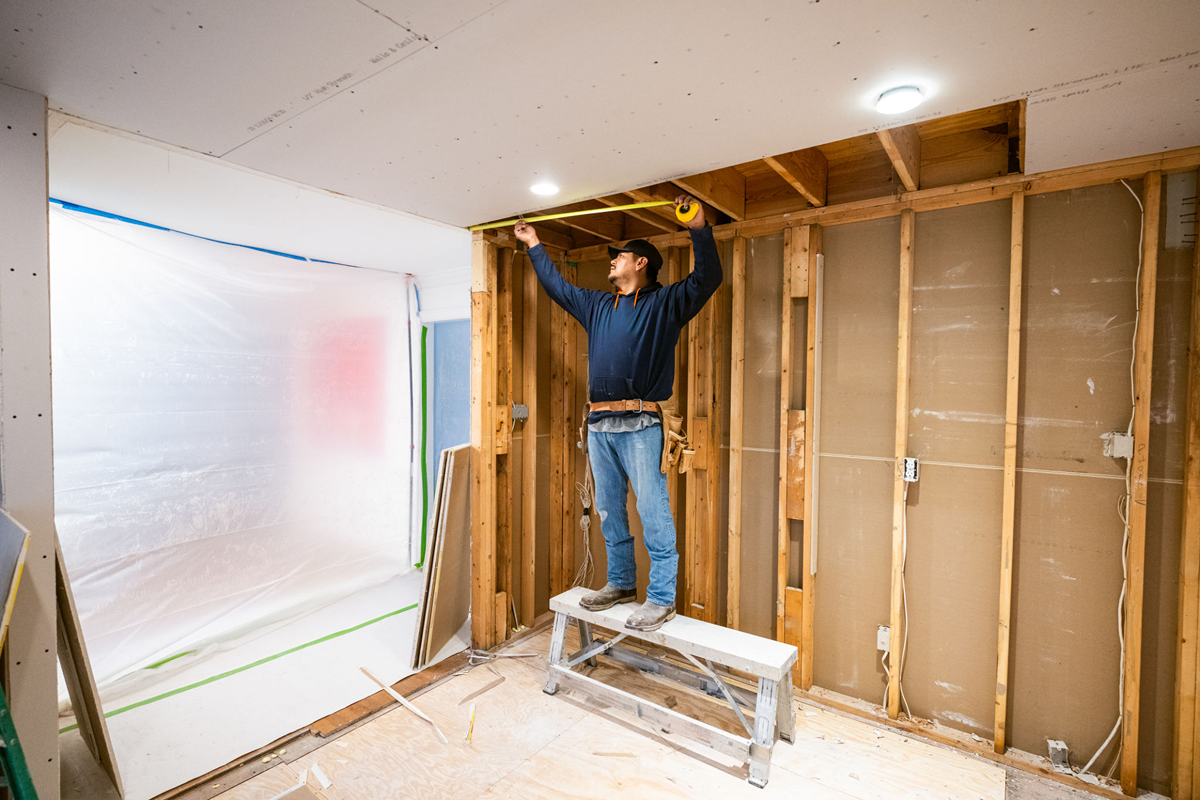
Demolition
Tear out of all damage. Sheet rock, studs, Cabinets, Plumbing fixtures, Flooring, Electrical fixtures etc. When dealing with electrical, plumbing, gas appliances if you are not skilled with these you should seek professional help. Your life or the life of loved ones may depend on it.
Getting Materials
Simply going to the hardware store may not be so simple. You will need to check prices, Locate different suppliers for items you want. Determine if the Subcontractors provide materials for their work. What parts will need to be ordered or custom made.
The Sequence of New Construction
When each part will be rebuilt or installed. How much of the work you will do your self and when you will do your part, and when to schedule the subcontractor. You will need to know when they can put you on their schedule. Remember you are not their only customer, it may be a while before they can get to you depending on how many jobs they already have scheduled. When you determine what subcontractors and you have decided on who you want to do the work at the very beginning you should get on their schedule. Don’t wait until you are ready for them. If your part takes longer than you expect let your subcontractor know as soon as you know.
Sequence
Demolition
This is where you will discover any non visual damage or surprises which my effect your original cost projections that could turn a simple repair into a major remodeling project. Once all of the damage is removed take a close look and assess the plan going forward. If there are hazard conditions this is where remediation needs to be made.
Clean up
Any trash or scraps left from demolition may contain hazardous remnants. Junk laying around can also create trip hazard, fatigue while working Nails or screws can cause injury or damage to new construction materials. You should create a safe environment to work in and for new materials or supplies.
Sub Floors
If the sub floor is damaged removal of the damaged sub floor will expose the floor joists. Determine if there is damage to the floor joist are also damaged. If the joist or joists are deteriorated they may need replaced, If the damage effects only part of the joist you may be able to nail a new joist to the old joist. If the majority of the existing joist is deteriorated you may need to replace it. If there is just some deterioration along the top of the joist that may cause new sub floor to not line up with other existing sub floor you should be able to nail a piece of lumber along the side of the joist to keep the sub floor where it should be. Replace damaged sub floor. The edge of the new sub floor should end at the center of the floor joist. Locate the center of the next good joist, Chalk or use a straight edge to mark where the center of the joist is (3/4 inch), cut the existing sub floor on the line which gives you good support for both old and new sub floor.
Stud Walls & Beams
If you have removed walls to be replaced or if you are adding new walls this is the time to build walls or add beams if the walls that were removed were bearing walls.
Mechanical
Heating, Plumbing and Electrical. If new or additional heating and duct work this should be done before Plumbing or Electrical. Heating duct runs are required to be in specific places. Next should be Plumbing then Electrical. Some times if the subcontractors are willing they can be on the job at the same time, they usually work well with each other. Tubs and Showers typically need to be installed fastened directly to the studs before the sheet rock or other wall coverings. Some tubs and showers require being “bedded” which means during the installation they need concrete (sand mix) underneath, the concrete needs to be mixed like with water and placed on top of the Sub floor then the the tub or shower put in place immediately while the concrete is wet. This is done whether it is wood sub floor or concrete slab. The reason for bedding is because the material that the tub or shower is made of will flex a little when getting in or out after bathing or showering which over time can cause the unit to crack which can cause leaks and water damage.
Wall coverings
Sheet rock, wood, paneling, etc. Of course you may use differing products such as sheet rock on some walls and tung & groove on other walls. If you are using thin paneling or bead board panels you will need to install them over sheet rock. If paneling over sheet rock you won’t need to do a finish mud but you will need to at least do fire taping, which is your first taping coat to seal the joint. If you are going to use tile you will need to use a tile backer rather than standard sheet rock. In areas where you are going to use sheet rock but are prone to moisture such as Bath room, Laundry and kitchen certain areas need to be moisture resistant sheet rock, ( typically blue or green) Moisture resistant sheet rock should be used behind sinks and washing and drying machines. Some other wall coverings are quite popular, like Ship Lap, Tung & groove etc. These are typically install directly to the Studs. Stone may require lath & plaster or a backer board. (see tile)
Tile
Tile can be installed before or after paint, Tile requires special type of material typically referred to as “backer board”. The old school method was “lath & plaster” which may still be used rarely, lath and plaster is a lot more work and doesn’t usually save any money. Backer board can any type of suitable material. One of the most popular is Called “Hardy Board” which Is a fiber reinforced cement board was invented by a person who’s name is James Hardy who was a siding installer, he originally invented the cement board as a siding product which is also quite popular. Several other companies make a similar cement board. Hardy board products come in 3′ X 5′ sheets either 1/4″ thick or 1/2 inch thick. Other types of backer board may be a product called Wonder board, which is also a type of fiber reinforced product, Wonder board is much more difficult to work with and has lost popularity since Hardy board was invented. Another backer board is called “Dens Shield” which is a gypsum reinforced fiber board which resembles sheet rock, Dens shield comes in 4′ X 8′ sheets, with a water proof face side resembling vinyl and fiberglass back with fiber impregnated in the gypsum. Dens Shield works great for walls because it covers more area at a time. I usually use it on the walls and the Hardy board on floors. The backer board can be installed prior to paint, just remember to not to paint the backer board.
Trim
Wood work, Doors, shelves, casing, baseboard, crown mold. If you are using paint grade (unpainted) which will be painted this is typically installed prior to paint. This is so you can fill nail holes and caulk seams before you paint except where you will have hard surface flooring such as vinyl, hardwood, LVP/LVT (Luxury Vinyl Plank or Luxury Vinyl Tile). In this case you should Paint some base and store it until you are ready to install it after the hard surface flooring is in place. Also if the base is going to butt up to cabinets or stone you will want to install the base after they are installed.
Wall Finishes
Of course Paint is the most common wall finish. Typically the nail holes and caulk are applied before painting, Then primer then paint. Before painting you should be sure to remove as much of the drywall sand as possible from the walls and floors. Most drywall installers and painters depend on the “other guy” to remove drywall dust from the walls so it never gets done, but it should. For the walls you can use a dry mop (similar to a Swiffer style) to go over all the walls, Use a vacuum to clean the floors. A paint sprayer can blow dirt off the floor onto the walls, doors, and wood work If you are using paint with a lot of color it is a good idea to have the primer “tinted” with the same color as the paint which helps the color coat go on nicer. Some companies make a all in one primer/paint. Supposedly so you can get by with only one coat. I have found that to get a good paint job you still have to use at least 2 coats even with primer/paint. As for me it doesn’t seem to be a very good primer and it doesn’t be a very good paint. And it is expensive. Other types of finishes such as wall tile, Tung & groove, Ship Lap, Stone, Brick, etc are typically installed after paint. Be careful to prevent mortar from getting on the painted surfaces. If you are painting over another color that is significantly different in color it is a good idea to paint the old surface with a grey coat prior to painting the final coat. Red and paint with red are very difficult to cover, painting with a grey paint will make life a lot easier for you.
Painting
When remodeling painting is commonly done by the owner or remodeling contractor. Special care is required not to allow paint to ruin other existing elements of the house usually with plastic or cloth tarps. Mask cabinets, windows etc.
Floor Coverings
Vinyl, Carpet, Hardwood, Vinyl Plank, Tile or other types of floor coverings.
Hard Wood and Vinyl are a series of “Butt” or interlocking joints. Where ever there are joints there is the possibility to leakage. Even Tile can form tiny cracks in the grout. A protective layer of water proof material should be installed under products that are vulnerable to moisture leakage.
Cabinets
Cabinets come in a variety of styles, shapes, sizes, and colors. Some may be Hard wood, some may be particle board with a veneer. Some may be an in expensive wood that are painted. (Paint grade are typically particle board or MDF) MDF is Medium Density Fiber and is usually recycled paper products. You may have to do a bit of work and research to find the cabinets you want. Most Cabinet shops have their specialty so you may have to shop around.